Roth Conversion Strategy for Retirees
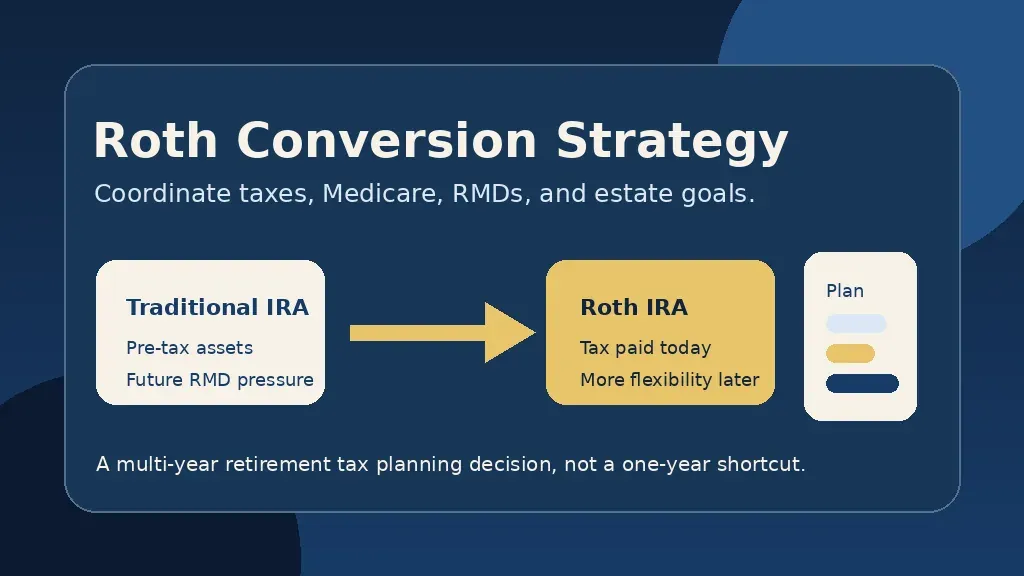
A Roth conversion strategy can be useful in retirement, but only when the tax cost today improves flexibility later. The basic move is simple: transfer assets from a traditional IRA or other eligible pre-tax retirement account into a Roth IRA, recognize taxable income in the conversion year, and potentially reduce the amount left in accounts that may create required minimum distributions later. The planning question is harder. Retirees need to weigh tax brackets, cash reserves, Medicare IRMAA, Social Security taxation, estate goals, and the value of keeping options open.
If you want help evaluating how a Roth conversion fits into a full retirement income plan, schedule a conversation with Hoxton Planning & Management.
This article is educational, not individualized tax advice. A conversion decision should be reviewed with a qualified tax professional who can model your household’s filing status, deductions, income sources, and state tax situation.
What is a Roth conversion strategy?
A Roth conversion strategy is a deliberate plan for moving some pre-tax retirement money into a Roth account over one year or several years. Traditional IRA assets generally have not been taxed yet. When those dollars are converted, the taxable portion is included in income for that year. Roth IRAs then offer a different tax profile, including qualified tax-free withdrawals when requirements are met and no lifetime required minimum distributions for the original Roth IRA owner under current rules.
The goal is not to avoid taxes altogether. It is to decide whether paying a known tax bill now may reduce larger, less flexible tax exposure later. That tradeoff is especially relevant for households that retire before required minimum distributions begin, expect rising taxable income later, want more control over future withdrawals, or care about how retirement assets may pass to heirs.
Hoxton’s broader retirement planning work focuses on coordinating decisions rather than treating each account in isolation. That is the same lens behind a sound Roth conversion review. See retirement withdrawal strategies for related planning considerations.
When might retirees consider a Roth conversion?
Many retirees evaluate Roth conversions during years when taxable income is lower than it is likely to be later. That window often appears after work income stops but before Social Security benefits, pensions, or required minimum distributions fill the tax return. It may also appear after a business sale or one-time income event has passed. The right window is household-specific, but the pattern is consistent: conversions tend to deserve closer study when today’s marginal tax rate looks favorable relative to future projected income.
Lower-income years between retirement milestones
Suppose a household retires in its early or mid-60s, delays Social Security, and has not reached its applicable required beginning date for RMDs. Those gap years may offer room to convert a measured amount without creating the same tax crowding that may appear later. Rather than converting an arbitrary sum, a planner can estimate taxable income before the conversion and test how much additional income fits within a targeted bracket or planning threshold.
Large pre-tax balances that may create future pressure
Retirees with substantial traditional IRA and 401(k) balances may face required distributions that grow taxable income in later retirement. IRS guidance explains that traditional IRA owners eventually must take required minimum distributions, and insufficient distributions can create penalties. A Roth conversion strategy completed before that point may reduce the pre-tax balance subject to future RMD calculations, although it also accelerates income today.
Survivor planning for married couples
Tax planning can also change after the first spouse dies. The surviving spouse may file as a single taxpayer while managing many of the same assets and income sources. That smaller tax bracket structure can make later taxable withdrawals more expensive. Roth conversions are not automatically the answer, but survivor tax exposure belongs in the modeling.
How tax brackets shape a Roth conversion strategy
The phrase “fill the bracket” is common for a reason. A retiree may estimate baseline taxable income, then model a conversion amount that uses remaining space in a selected tax bracket without spilling more income into a higher one than intended. This is not a recommendation to fill any particular bracket. It is a framework for comparing options.
| Planning input | Why it matters | Question to model |
|---|---|---|
| Ordinary income before conversion | Determines how much bracket space may remain | What taxable income exists before adding a conversion? |
| Deductions and filing status | Change taxable income and the effective bracket | Will deductions or a filing status change alter the result? |
| Capital gains and portfolio income | Can interact with total taxable income | Could a conversion affect the tax treatment of other income? |
| State income taxes | May raise or lower the total conversion cost | Is a move to another state expected? |
Tax brackets are only one layer. A conversion that looks reasonable under federal bracket math can still be unattractive after considering Medicare premiums, state taxes, cash-flow needs, or a planned charitable strategy. Hoxton’s article on minimizing taxes on 401(k) withdrawals discusses why coordinated withdrawal planning matters in retirement.
Why Medicare IRMAA deserves attention
A Roth conversion increases income in the year completed, and Medicare may later use income information from a prior tax return to determine whether income-related monthly adjustment amounts apply. The Social Security Administration explains that higher-income Medicare beneficiaries may pay an additional amount for Part B and prescription drug coverage. In practice, that means a conversion can raise taxes now and potentially raise Medicare premiums later.
IRMAA should not automatically stop a conversion. In some cases, a household may willingly accept a premium increase because the long-range tax benefit still looks worthwhile. In other cases, crossing an IRMAA threshold for a small extra conversion may weaken the economics. The key is to model it before converting, not notice it after a premium notice arrives.
- Estimate modified adjusted gross income before and after the planned conversion.
- Compare conversion amounts that remain below or cross relevant premium thresholds.
- Review whether a qualifying life-changing event may affect how Medicare income is assessed.
- Coordinate with a tax professional before relying on threshold-sensitive estimates.
A conversion is only one part of retirement tax planning. To see how Hoxton organizes decisions across taxes, cash flow, and long-term goals, review the Hoxton Planning Experience.
How RMDs change the conversation
Required minimum distributions are a major reason retirees investigate Roth conversions. The IRS notes that owners of traditional IRAs generally must begin distributions by the applicable required beginning date. Once RMDs begin, those required withdrawals add taxable income and can leave less room for optional tax moves.
There are two important planning points. First, a conversion completed before RMD years may reduce the pre-tax account balance used in future RMD calculations. Second, after RMDs begin, the required distribution for that year generally has to be taken first and is not itself eligible for conversion. A retiree may still evaluate additional conversions after satisfying the RMD, but the tax picture is often tighter.
RMD planning also connects to charitable intent. Some retirees who are charitably inclined review qualified charitable distributions with their tax professional as a separate way to manage IRA distributions. A QCD is not a Roth conversion, and one should not be treated as a substitute for the other. Still, comparing the tools can prevent a household from overusing one strategy when a different tax provision better matches its goals.
This is why multi-year planning matters. A retiree who waits until RMDs start may have fewer low-income years available. A retiree who converts too aggressively too early may create avoidable taxes or premiums. A thoughtful Roth conversion strategy compares several years, not just the next tax return.
Should estate planning influence the conversion decision?
Estate goals can influence the analysis, especially when retirees expect to leave retirement assets to children or other non-spouse beneficiaries. Inherited account rules are complex and depend on the beneficiary and account type. Still, many families care about whether heirs may inherit a large pre-tax tax burden or a pool of assets with different withdrawal characteristics.
A conversion can also create more flexibility for the retiree while living. Having both taxable, tax-deferred, and Roth assets may help future withdrawals respond to tax law changes, market cycles, or uneven spending needs. That kind of tax diversification is not just an estate issue. It is a household resilience issue.
Estate planning should be coordinated with legal counsel, beneficiary designations, and tax advice. For a deeper look at the advisory role in legacy decisions, read how a financial advisor helps with estate planning.
What tradeoffs can make a Roth conversion less attractive?
A Roth conversion strategy is not a universal retirement rule. There are situations where the near-term tax cost may not justify the projected benefit, or where the household needs more analysis before acting.
- The conversion pushes income into a much higher bracket. Paying a higher rate today may be hard to justify if future taxable income is projected to be lower.
- The tax bill would be paid from the converted IRA itself. Using retirement assets to cover taxes can reduce the amount that moves into the Roth and may weaken long-term results.
- Medicare premiums or other income-tested costs rise sharply. Threshold effects deserve specific modeling.
- A major deduction or charitable plan is coming later. Timing can matter, and the most efficient conversion year may not be the current one.
- The retiree may relocate to a lower-tax state. State tax changes can alter the conversion math.
- Cash reserves are thin. A tax-efficient idea that strains liquidity may not improve the overall plan.
Good planning includes the cost of being wrong. A measured annual conversion can preserve flexibility better than one oversized transaction based on a narrow assumption.
A practical multi-year Roth conversion framework
Retirees do not need to guess. They can build a repeatable annual review process that keeps the conversion decision connected to the rest of the plan.
- Project baseline income. Include pensions, work income, portfolio income, Social Security, planned withdrawals, and other taxable items.
- Estimate deductions and filing status. A tax professional can help translate gross cash flow into a taxable income estimate.
- Identify planning bands. Review federal tax brackets, IRMAA exposure, state taxes, and any thresholds relevant to the household.
- Model several conversion amounts. Compare no conversion, a modest conversion, and a larger conversion rather than defaulting to one number.
- Review future RMD pressure. Test whether reducing pre-tax balances now may lower later taxable withdrawals.
- Confirm the tax payment source. Understand whether taxes can be paid from cash or taxable assets without undermining retirement spending.
- Revisit annually. Markets, tax law, deductions, health costs, and personal goals change.
This framework keeps the conversation practical. It does not require predicting every future tax law change. It requires understanding the range of plausible outcomes and deciding how much flexibility is worth buying today.
If your retirement plan includes large pre-tax accounts, approaching RMDs, or concern about survivor taxes, contact Hoxton Planning & Management to discuss the broader planning picture.
Roth conversion strategy questions to ask before acting
Before approving a conversion, retirees can use a short decision checklist:
- What is my projected taxable income with no conversion?
- What conversion amount fits the tax bracket or planning band I am comfortable evaluating?
- Could this raise future Medicare premiums through IRMAA?
- How does the conversion interact with Social Security timing, portfolio withdrawals, or capital gains?
- Would it reduce future RMD pressure in a meaningful way?
- Can I pay the tax without weakening my retirement cash reserve?
- Do my estate goals favor a different mix of pre-tax and Roth assets?
- Has a tax professional reviewed the projected tax return impact?
The bottom line
A Roth conversion strategy can help retirees manage future tax flexibility, RMD exposure, Medicare planning, and estate tradeoffs. It can also create unnecessary taxes when done without a multi-year view. The strongest approach is measured: model income, compare scenarios, understand threshold effects, coordinate with tax and estate professionals, and revisit the decision as retirement unfolds.
Hoxton Planning & Management serves serious savers nearing or living in retirement with coordinated financial planning, investment management, tax-aware strategy, and estate planning conversations. A Roth conversion is not a stand-alone answer. It is one lever inside a larger retirement plan.
Important disclosure: This article contains general information that is not suitable for everyone and was prepared for informational purposes only. Nothing contained herein should be construed as a solicitation to buy or sell any security or as an offer to provide investment advice. Hoxton Planning & Management LLC is a registered investment adviser. For additional information about Hoxton Planning & Management LLC, including its services and fees, send for the firm's disclosure brochure using the contact information contained herein or visit advisorinfo.sec.gov.
All investing involves risk, including the possible loss of principal. Past performance is not indicative of future results, and no investment strategy can guarantee profit or protect against loss in periods of declining markets. Tax laws are complex and subject to change. The tax information provided is general in nature and should not be construed as tax advice. Consult a qualified tax professional regarding your specific circumstances before making any tax-related decisions.