
Retirement Income Planning Checklist Before You Stop Working
Retirement income planning gets real when your paycheck is about to stop. The question is no longer only whether you saved enough. It is whether your savings, Social Security, taxes, healthcare costs, and investment risk can work together to support the life you want. A checklist helps you turn those moving parts into decisions you can review before retirement begins.
Want a second set of eyes on the transition from saver to spender? Schedule a planning discussion with Hoxton Planning & Management.
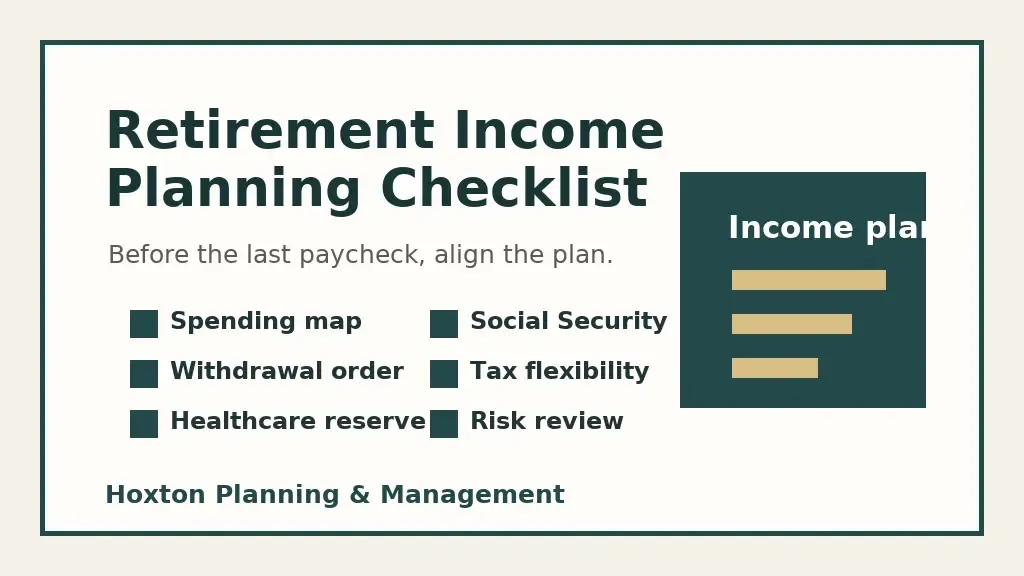
This guide is written for serious savers who are nearing retirement, especially people who have spent years accumulating accounts but now need a coordinated income plan. It is not a replacement for personal advice. It is a practical way to spot gaps, organize conversations, and avoid treating retirement as a single yes-or-no number.
What is retirement income planning?
Retirement income planning is the process of turning accumulated resources into a sustainable spending plan for life after work. It connects expected expenses with income sources, decides how withdrawals may be sequenced, considers taxes and healthcare costs, and sets guardrails for investment risk. A sound plan is specific enough to guide decisions, but flexible enough to adjust as markets, tax rules, and personal priorities change.
That makes retirement income planning different from general saving advice. While working, contributions and long time horizons can mask weak coordination. Near retirement, timing matters more. Claiming Social Security, realizing income in a high-tax year, selling investments after a decline, or ignoring healthcare costs can all affect the same pool of future cash flow.
A useful plan answers six questions:
- What does retirement spending actually need to cover?
- Which income sources are dependable, and when do they start?
- How will portfolio withdrawals be organized?
- Where could taxes reduce spendable income?
- How will healthcare and long-term care uncertainty be addressed?
- Is the investment plan aligned with taking withdrawals, not just chasing returns?
Retirement income planning checklist at a glance
| Checklist area | Decision to make | Why it matters |
|---|---|---|
| Spending | Separate essential, flexible, and one-time costs | Income needs become clearer than a broad income replacement rule. |
| Social Security and pensions | Map claiming dates and survivor implications | Permanent income decisions shape the lifetime plan. |
| Withdrawals | Define account order, cash needs, and guardrails | Reduces ad hoc selling and keeps income decisions coordinated. |
| Taxes | Review taxable, tax-deferred, and Roth flexibility | The same gross withdrawal can create very different net income. |
| Healthcare | Plan for pre-Medicare, Medicare, and out-of-pocket costs | Medical spending can change the cash-flow picture quickly. |
| Investment risk | Match reserves and allocation to the income plan | Sequence risk is most uncomfortable when withdrawals begin. |
If you want a related pre-retirement self-review, Hoxton’s Retirement Readiness Checklist can help you identify broader planning questions before a meeting.
1. Turn your spending estimate into a cash-flow map
Start retirement income planning with spending, not investment returns. A portfolio can only be tested against a clear demand for cash. Instead of beginning with a broad rule such as replacing a fixed percentage of salary, outline what you expect to spend and when.
List the three layers of retirement spending
- Essential spending: housing, utilities, food, insurance, taxes, and baseline healthcare.
- Lifestyle spending: travel, hobbies, gifts, dining, and family experiences that matter but can be adjusted.
- Irregular spending: vehicles, home projects, relocation, major celebrations, or help for adult children.
This breakdown is useful because each layer may need a different funding strategy. Essential costs usually call for the highest confidence. Flexible lifestyle expenses can absorb more variation. One-time goals often need their own timing decisions so they do not surprise the withdrawal plan.
Checklist for spending assumptions
- Review the last 12 months of actual bank and card activity.
- Remove work-only costs that may disappear, then add retirement-only costs that may rise.
- Estimate taxes as a spending category rather than as an afterthought.
- Separate recurring expenses from planned large purchases.
- Discuss which lifestyle costs are priorities and which could be delayed during a weak market.
If household cash flow is still fuzzy, the Net Worth & Budget Worksheet can provide a simple starting point for organizing assets, liabilities, and spending inputs.
2. Inventory income sources before choosing withdrawal amounts
Your portfolio is not the only source of retirement cash flow. A useful income map shows what may arrive automatically, what is optional, and what depends on market withdrawals. This keeps the plan from treating every dollar as if it carries the same timing and risk.
Build an income source timeline
- Social Security benefit estimates for each spouse or household member.
- Pensions, deferred compensation, or annuity income if applicable.
- Part-time work, consulting, rental income, or other recurring cash flow if reasonably expected.
- Required or planned distributions from retirement accounts.
- Taxable investment withdrawals, Roth withdrawals, or cash reserves.
The timeline matters. A household retiring before Social Security begins may need bridge income for several years. Another household may retire after pension and Social Security income already cover a meaningful portion of baseline expenses. Those are different income planning problems.
Midpoint check: If your retirement date is approaching, schedule a planning discussion to connect your spending map, income sources, and withdrawal choices.
3. Review Social Security as an income strategy, not a filing form
Social Security is often one of the few inflation-adjusted lifetime income sources retirees have. That does not mean one filing age fits everyone. Claiming decisions should be evaluated alongside cash needs, health considerations, longevity expectations, marital status, survivor benefits, and tax interactions.
Questions to discuss before claiming
- Will claiming earlier reduce pressure on investments, or would waiting improve long-term household resilience?
- For couples, how might the higher earner’s claiming choice affect survivor income?
- Would temporary portfolio withdrawals create room for a later benefit, and is that trade-off acceptable?
- How could Social Security income combine with IRA distributions, pensions, or part-time work for tax purposes?
Do not isolate the Social Security decision from the rest of the plan. It is a lifelong income lever. A filing age that looks attractive in a spreadsheet may be less appealing if it increases portfolio stress in the wrong years, or if it weakens a surviving spouse’s future income.
4. Create a withdrawal policy before markets test your patience
A retirement portfolio becomes easier to mismanage when every market decline feels like it threatens the next grocery bill. A withdrawal policy cannot remove uncertainty, but it can define how cash will be raised and when the plan deserves a review. The goal is not blind automation. The goal is fewer emotional, last-minute decisions.
Define the withdrawal building blocks
- Near-term liquidity: identify cash needed for upcoming expenses and how it will be replenished.
- Account sequencing: consider taxable accounts, tax-deferred accounts, and Roth assets in coordination with the tax plan.
- Rebalancing discipline: decide whether withdrawals can help bring the portfolio back toward its target allocation.
- Guardrails: determine which spending categories could flex if markets decline or inflation surprises.
- Review cadence: set an annual or event-driven check instead of redesigning the strategy every month.
Withdrawal sequencing is where income planning, tax planning, and investment planning meet. For example, a plan that draws only from traditional retirement accounts may increase taxable income unnecessarily in some years. A plan that ignores future required distributions may postpone a tax issue rather than solve it. Hoxton’s article on how to minimize taxes on 401(k) withdrawals goes deeper into withdrawal-related tax considerations.
5. Stress-test the tax plan, not just the portfolio
Retirees spend net income, not gross withdrawals. Tax planning matters because income sources can be taxed differently, and retirement may create years with unusual flexibility. The years after work income ends but before certain lifetime income streams or required distributions begin can be especially important to review.
Tax questions for the checklist
- How much planned cash flow could come from taxable, tax-deferred, and Roth accounts? (For more details, see our guide on tax diversification in retirement.)
- Could a large one-time purchase create a larger-than-expected tax bill?
- Would charitable giving, capital gains realization, or Roth conversion discussions fit into the broader plan?
- How could income decisions affect Medicare premiums, state taxes, or the taxability of Social Security?
- Are beneficiary designations and estate planning documents consistent with account ownership?
A checklist does not produce tax advice by itself. It highlights where financial and tax professionals may need to coordinate. Hoxton’s Tax Strategy Planning Calendar can help households identify planning moments across the year rather than waiting until forms arrive.
6. Plan for healthcare before it becomes an emergency line item
Healthcare deserves its own section in retirement income planning because it changes with age, employment status, family circumstances, and insurance decisions. Retiring before Medicare eligibility creates one planning path. Retiring at or after Medicare eligibility creates another. Neither path should be handled with a single blanket estimate.
Healthcare checklist before retirement
- Confirm how coverage will work between retirement and Medicare eligibility, if there is a gap.
- Review Medicare enrollment timing, supplemental coverage choices, and prescription drug needs.
- Budget for premiums, deductibles, dental, vision, hearing, and other out-of-pocket expenses.
- Discuss long-term care exposure, family caregiving assumptions, and liquidity needs.
- Revisit health savings account balances and intended uses, if applicable.
Healthcare planning is not only about projecting a large lifetime number. It is about understanding the specific cash-flow demands that may show up early, later, or suddenly. A healthy plan leaves room for uncertainty instead of using every dollar of retirement cash flow for visible lifestyle goals.
7. Align investment risk with the fact that withdrawals are starting
Investment risk feels different once a household begins taking income. During accumulation, market declines can be uncomfortable while regular contributions continue. During distribution, the same decline may coincide with withdrawals, which can make losses harder to recover from. This is often called sequence risk.
The answer is not automatically to eliminate growth assets. Retirement can last decades, and inflation still matters. The better question is whether the portfolio, cash reserves, and spending flexibility are aligned with the income plan. Hoxton’s guide on how to build a retirement portfolio covers the asset allocation side of that discussion.
Investment risk checklist
- Compare current allocation with the risk level the household can actually tolerate during withdrawals.
- Clarify the purpose of cash and short-term reserves.
- Review concentration risk, especially in employer stock or highly appreciated positions.
- Define a rebalancing process before volatility arrives.
- Test how spending choices could change after a weak first year of retirement.
8. Put the retirement income checklist into a one-page action list
A retirement income plan becomes more useful when it produces a short list of actions. The details may live in spreadsheets and account statements, but the final review should show what needs attention now, what should be monitored, and what decisions can wait.
One-page planning summary
- Write the target retirement date and any flexible alternatives.
- List essential monthly spending and major planned one-time expenses.
- Show when each expected income source begins.
- Document the first-year withdrawal approach and cash reserve plan.
- Record open tax questions for the next planning conversation.
- Identify healthcare enrollment dates and unresolved insurance questions.
- Set the next portfolio risk and allocation review date.
This action list is also a helpful way to identify what still feels uncertain. If two spouses answer a checklist item differently, that is not failure. It is useful planning information. Retirement income planning works best when assumptions are made visible before they become pressure points.
Ready to turn the checklist into a coordinated retirement income plan? Schedule a planning discussion with Hoxton Planning & Management.
Retirement income planning FAQ
When should retirement income planning begin?
It becomes especially valuable in the years before retirement, when Social Security timing, tax opportunities, healthcare coverage, and portfolio withdrawals can still be coordinated. Starting earlier can make the transition less rushed, but even households close to retirement can benefit from organizing the plan.
How is retirement income planning different from retirement saving?
Saving focuses on accumulating assets. Retirement income planning focuses on converting those assets and other income sources into spendable cash flow while managing taxes, healthcare costs, and investment risk.
Should I claim Social Security as soon as I retire?
Not automatically. The better decision depends on household cash flow, longevity considerations, survivor benefit concerns, tax interactions, and how withdrawals would work if benefits are delayed. It should be reviewed as part of the larger income plan.
What is the biggest gap people miss before retirement?
Many savers know account balances but have not connected spending, income timing, taxes, and healthcare into one plan. That gap can make a household look prepared on paper while still leaving major decisions unresolved.
How often should a retirement income plan be reviewed?
At least annually, and again when retirement dates, tax rules, health circumstances, marital status, or major spending goals change. The plan should be durable, not frozen.
Important disclosure: This article contains general information that is not suitable for everyone and was prepared for informational purposes only. Nothing contained herein should be construed as a solicitation to buy or sell any security or as an offer to provide investment advice. Hoxton Planning & Management LLC is a registered investment adviser. For additional information about Hoxton Planning & Management LLC, including its services and fees, send for the firm's disclosure brochure using the contact information contained herein or visit advisorinfo.sec.gov.
All investing involves risk, including the possible loss of principal. Past performance is not indicative of future results, and no investment strategy can guarantee profit or protect against loss in periods of declining markets. Tax laws are complex and subject to change. The tax information provided is general in nature and should not be construed as tax advice. Consult a qualified tax professional regarding your specific circumstances before making any tax-related decisions.